Have you ever stared at your phone, unsure of what to say to someone you barely know?
Knowing how to write a message for someone you barely know can be stressful, but it doesn’t have to be.
Writing a message is simple when you follow a few clear rules: keep it short, polite, and clear.
Start with a brief greeting, state your purpose in one sentence, and end respectfully. Use neutral language, avoid personal details, and focus on context.
In this guide, you’ll learn exactly what to say, what to avoid, and see practical examples to start a conversation confidently.
Hencreforth, let’s get started!
Why First Messages Feel Awkward?
Sending a first message to someone you barely know can feel surprisingly stressful, even in a world where texting and messaging dominate communication.
Much of this discomfort comes from the lack of vocal tone, facial expressions, and body language in written text, which makes it harder to gauge how your words will be interpreted.
Additionally, many people overthink potential mistakes, worry about being judged, or fear rejection.
Because texting doesn’t provide instant feedback like a conversation in person, it can leave your brain stuck in hesitation.
Common Mistakes People Make in First Messages
Here are the most frequent pitfalls.
1. Overthinking Every Word: Constantly rewriting your message before sending creates unnecessary stress.
2. Writing Long, Complex Messages: Lengthy texts can overwhelm someone who barely knows you. Short, simple messages are easier to read and reply to.
3. Using Ambiguous or Unclear Language: Text lacks tone and nonverbal cues, so humor, sarcasm, or vague phrasing can be misinterpreted.
4. Crossing Social Boundaries Too Soon: Avoid overly personal questions, assumptions, or comments that may feel intrusive.
5. Overusing Emojis or Casual Slang: A few well-placed emojis can add warmth, but too many can make your message seem childish or confusing.
6. Neglecting Basic Clarity: Typos, grammatical errors, or poorly structured sentences can distract from your message and make it appear careless.
7. Focusing Too Much on Yourself: Opening with long personal stories or self-centered details can overwhelm the recipient.
Step-by-Step: How to Write a Message for Someone You Barely Know
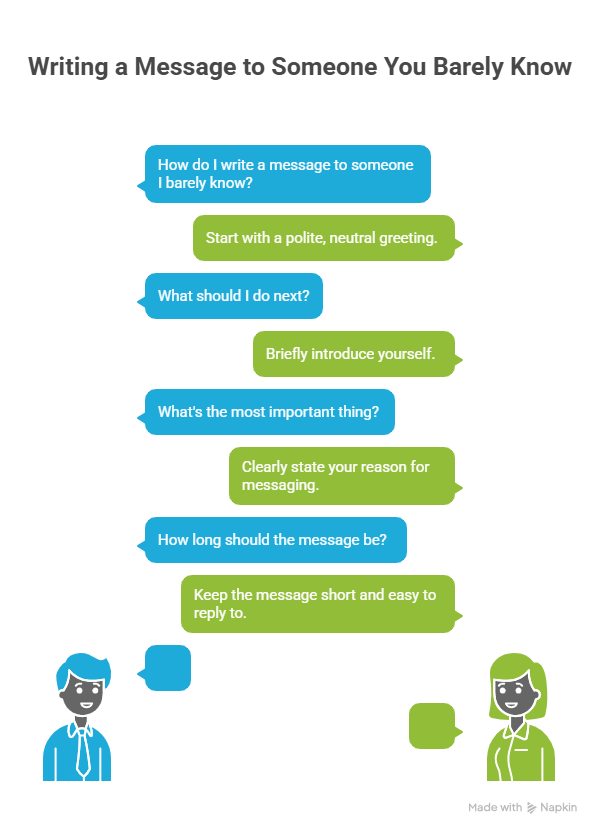
These strategies help your message feel approachable, clear, and considerate.
Step 1: Start With a Polite, Neutral Greeting
Using a neutral opener like “Hi [Name],” or “Hello,” conveys friendliness and reduces social friction.
Research shows that greetings function as a digital handshake; they signal intent and respect before you dive into the main content.
Step 2: Briefly Introduce Yourself
Keep it short and relevant: one sentence explaining who you are and how you’re connected. For example:
“It’s [Your Name] from the webinar yesterday” or “This is [Your Name]; we met at the networking event.”
Avoid long self-introductions; clarity and brevity signal thoughtfulness and respect for the recipient’s time.
Step 3: Clearly State Your Reason for Messaging
A concise sentence that clearly states your purpose helps the recipient understand why you’re reaching out and what’s expected.
This is similar to how to write a heartfelt message, where clarity and genuine intent make all the difference.
For example, if you have a question, make it explicit,
“I wanted to ask your opinion on [topic]” or “I thought you might have insight on [project].”
Step 4: Keep the Message Short and Easy to Reply To
Aim for 2 – 4 simple sentences that can be read in seconds and answered quickly.
Long, dense paragraphs can overwhelm someone you barely know and reduce the likelihood of a response.
Your first message should be an invitation to converse, not a detailed report.
Step 5: End With a Low-Pressure Closing
The way you close a message shapes how comfortable the recipient feels. Use polite, relaxed phrases like,
- “Thanks for your time!”
- “Looking forward to your thoughts.”
- “Hope you’re having a great day.”
Avoid language that pressures the recipient to reply immediately or feels demanding. A
How to Adjust Your Message Based on Context
Below are practical, expert-backed guidelines for three common scenarios: professional contacts, casual acquaintances, and people you meet online or on social media.
1. Messaging a Professional or Work Contact
When messaging a professional, clarity and courtesy are essential. Begin with a polite greeting, clearly identify yourself, and state your purpose concisely:
“Hello [Name], I’m [Your Name] from the marketing team. I wanted to follow up on the proposal we discussed.”
Professional messages that are clear, concise, and polite signal competence and respect.
2. Messaging a Casual Acquaintance
Messages to casual acquaintances can be more relaxed but should remain respectful. Begin with a simple greeting and remind them how you’re connected,
“Hey [Name], it’s [Your Name] from the networking event last week.”
A friendly tone helps reduce awkwardness and establishes rapport without overstepping boundaries.
3. Messaging Someone Online or on Social Media
Online messaging requires extra attention to trust, clarity, and safety. Start with a transparent greeting that references how you found them.
“Hi [Name], I saw your post about [Topic], and it really resonated with me.”
Focused, respectful messaging online builds trust and increases the likelihood of engagement.
Message Examples for Different Situations
Each template is polite, context-aware, and structured to encourage a natural, comfortable reply.
1. Shared Interest Message Example
Hi [Name], I saw your post about [Topic/Interest] and really appreciated your perspective. I’ve been exploring that myself and found it fascinating, especially your point about [specific detail]. Would love to hear more of your thoughts if you have time. No pressure!
Tip: Use this for reaching out to someone whose content, ideas, or activities align with your interests.
2. Simple Introduction Message Example
Hello [Name], this is [Your Name]. We met at [Event/Place] last week. I enjoyed our conversation about [Topic] and wanted to say hello. Hope you’re having a great day!
Tip: Ideal for networking, social events, or casual acquaintances.
3. Compliment-Based Message Example
Hey [Name], I really enjoyed your recent post about [Topic]. Your insight on [specific point] was thoughtful and gave me a fresh perspective. Just wanted to share my appreciation. Thanks for sharing your ideas!
Tip: Perfect for reaching out to someone you admire or want to connect with professionally or socially.
What to Avoid When Messaging Someone You Don’t Know Well
Here are the key pitfalls to steer clear of when contacting someone you barely know.
1. Messaging at Inappropriate Times or Too Frequently
Sending messages late at night, early in the morning, or during someone’s work hours can feel intrusive.
Similarly, sending multiple messages in rapid succession can overwhelm the recipient and create pressure.
2. Using All Caps, Excessive Emojis, or Slang
All caps can come across as shouting, while too many emojis, GIFs, or casual slang can confuse or distract the reader.
Use expressive elements sparingly, only when they enhance clarity or friendliness.
Professional and neutral language is safer for first interactions.
3. Sending Long, Unfocused Messages
Aim for short, concise sentences that clearly communicate your purpose.
Think of your message as an invitation to converse, not a detailed essay.
4. Oversharing Personal Details Too Soon
Emotional stories, financial details, or deeply personal anecdotes can make the recipient uncomfortable.
Focus on context and relevance, why you’re reaching out, where you know them from, or shared interests.
5. Making Assumptions or Misreading Tone
Avoid assuming meaning from brief responses or silence. Misreading tone can lead to overtexting or frustration.
If in doubt, clarify politely rather than guessing intent.
6. Generic Openers Without Context
Messages like “Hi” or “Hello” without any context leave the recipient guessing.
Include a clear reason for reaching out in your first message.
7. Discussing Sensitive or Controversial Topics Early
Avoid politics, religion, or controversial topics in your initial message.
These subjects can create discomfort or tension.
Stick to neutral, friendly, and context-appropriate topics until trust is established.
8. Ignoring Grammar, Clarity, or Tone
Typos, poor punctuation, or confusing phrasing can make your message hard to read and signal carelessness.
Proofreading your message demonstrates thoughtfulness and professionalism.
FAQs
1. Is it okay to message someone you barely know?
Yes, it’s perfectly fine to message someone you barely know, but as long as you approach it respectfully and considerately. Start with a brief greeting, clearly state your purpose, and keep the tone polite and neutral. Avoid overly personal questions or assumptions, and focus on context.
2. How long should the message be?
Keep your message short and easy to reply to, ideally 2 – 4 sentences, or around 50 – 125 words. Long messages can overwhelm someone you barely know and reduce the likelihood of a response.
3. What if they don’t reply?
If the recipient doesn’t respond, don’t panic or double-text immediately. People may be busy, unsure, or hesitant. Give them time, and if needed, follow up politely after a few days with a single, concise message.
4. Can I use emojis or casual language in my first message?
Use them sparingly. A single emoji can add friendliness or warmth, but too many emojis, slang, or informal language may be misinterpreted. Keep the tone neutral, professional (if appropriate), and context-aware.
5. How should I close the message?
End with a low-pressure, polite closing that invites a response without demanding one. Examples include,
- “Looking forward to your thoughts!”
- “Thanks for your time!”
- “Hope you have a great day!”
Final Words
Crafting a first message to someone you barely know doesn’t have to feel stressful. The foundation of a positive impression lies in clarity, respect, and tone.
Keep your messages short, polite, and context-aware, and make sure your intent is immediately understandable.
Avoid assumptions, oversharing, or overly casual language, and always close with a low-pressure, considerate ending.
Remember, the goal is to make the recipient feel comfortable, acknowledged, and open to responding.
By prioritizing trust, thoughtfulness, and relevance, even a simple message can create a strong, positive first impression.
Gift Me What – Where Every Gift Finds Its Perfect Match!